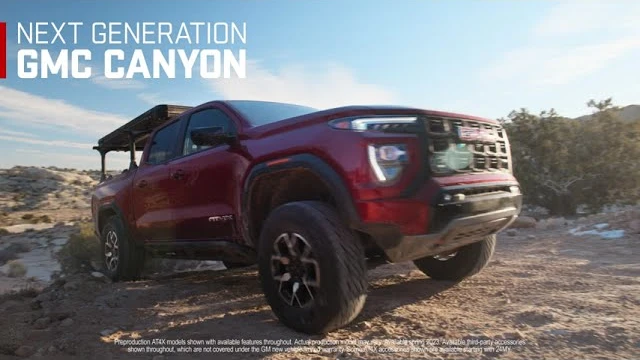
- 2027 GMC Canyon engine output rises to 350 horsepower and 455 lb-ft of torque.
- Major hardware changes include a new turbocharger, higher-pressure fuel injection, and piston updates.
- Performance shifting focuses on keeping the engine between 2,000 and 4,000 rpm.
- Towing capacity is described as 7,700 pounds for the base truck and 6,000 pounds for the ZR2.
- Off-road hardware remains largely familiar, including the reported 33-inch tires and front and rear lockers on AT4X.
2027 GMC Canyon Engine Overview
The 2027 GMC Canyon engine is a turbocharged four-cylinder powerplant with a significant output increase over the previous version. The updated truck is described with 350 horsepower, compared with 310 horsepower before, and 455 lb-ft of torque. That makes the power upgrade relevant for both acceleration and loaded driving rather than a minor specification adjustment.
The central change is not simply additional boost. The updated engine uses a different turbocharger, a higher-pressure fuel-injection system, and revised pistons. These changes indicate a broader calibration and hardware revision designed to deliver stronger performance while maintaining the Canyon’s midsize-truck character.
Video Highlights:
- Output increases from 310 horsepower to 350 horsepower.
- Torque is listed at 455 lb-ft.
- The turbocharger and fuel system receive hardware updates.
- Revised pistons support the updated engine package.
- Performance shift programming targets the 2,000–4,000 rpm power band.
| Engine area | 2027 Canyon update | Practical meaning |
|---|---|---|
| Layout | Turbocharged four-cylinder | Compact powertrain with strong torque delivery |
| Horsepower | 350 hp | More output than the previous 310-hp version |
| Torque | 455 lb-ft | Stronger response for acceleration and trailering |
| Turbocharger | New turbocharger | Revised airflow and boost hardware |
| Fuel system | Higher-pressure injection | Supports the revised power target |
| Internal components | Piston changes | Updated engine hardware for the new calibration |
The most important takeaway is the combination of hardware and calibration changes. Treat the 2027 update as a coordinated engine revision rather than a simple software-only power increase.
What Changed Under the Hood
The 2027 revision adds several mechanical changes beneath an otherwise familiar Canyon design. The engine engineer describes a completely different turbocharger, a higher-pressure fuel-injection system, and piston revisions. Together, those updates help explain why the truck gains 40 horsepower over the earlier configuration.
The engine sound is also described as more refined. The revised four-cylinder has less combustion noise and a deeper tone than the previous L3B engine. GMC also uses engine sound enhancement inside the cabin, but the goal is described as a fuller character rather than a heavily amplified exhaust-style experience.
| Component | Previous reference | 2027 direction | Why it matters |
|---|---|---|---|
| Turbocharger | Earlier turbo hardware | New turbocharger | Supports the higher output target |
| Fuel injection | Previous system | Higher-pressure injection | Helps manage the revised combustion strategy |
| Pistons | Earlier piston design | Updated pistons | Matches the revised engine hardware |
| Engine sound | More combustion noise | Cleaner, deeper tone | Improves perceived refinement |
| Cabin sound | Existing enhancement | Fine-tuned enhancement | Adds character without excessive noise |
Turbocharger and Fuel Delivery
A new turbocharger is the most visible performance change discussed for the engine. However, turbo hardware works together with fuel delivery, piston design, and calibration. The higher-pressure injection system is therefore an important part of the upgrade, especially when the truck is asked to accelerate under load.
The available material does not provide a full boost-pressure chart, fuel-economy rating, displacement breakdown, or service interval schedule. Those details should be confirmed through the final vehicle documentation for the specific truck and market.
Refinement Instead of Noise
More power does not automatically mean a louder or harsher truck. The updated engine is described as having less combustion noise and a deeper grunt. That distinction matters for owners who use the Canyon as a daily driver, because refinement remains part of the truck’s value alongside trail capability.
Do not infer fuel economy, boost pressure, engine displacement, or service intervals from the power figures alone. Confirm those details against the final configuration and owner documentation.
Performance Calibration and Driving Feel
The 2027 Canyon’s performance improvement is supported by revised transmission behavior. In performance shift mode, the calibration is designed to keep the engine within a 2,000–4,000 rpm operating range. Staying in that band helps the truck respond more quickly when the driver requests acceleration.
The reported driving impression is a noticeable improvement over the previous truck, particularly when trailering. The updated powertrain is also intended to preserve the Canyon’s manageable midsize footprint. That balance is important: the truck gains output without changing the basic reason many buyers choose a midsize pickup.
More Output
350 horsepower and 455 lb-ft provide a clear increase over the earlier 310-hp setup.
Better Power Access
Performance shifting works to keep the engine between 2,000 and 4,000 rpm.
Daily Refinement
Lower combustion noise and a deeper tone support comfortable everyday driving.
Select the Right Drive Setting
Use the normal setting for routine commuting and mixed driving. Reserve performance-oriented shifting for situations that require quicker response, such as merging, climbing, or controlled trail work.
Build Speed Smoothly
Apply throttle progressively so the turbocharged engine can deliver its torque without unnecessary wheelspin or abrupt gear changes.
Use the Power Band
When stronger acceleration is needed, allow the transmission to work within the reported 2,000–4,000 rpm range rather than forcing an early upshift.
Manage Loads Carefully
When towing, use the appropriate trailer equipment and follow the rating for the exact Canyon trim. The available figures differ between the base truck and ZR2.
| Driving situation | Recommended approach | Reason |
|---|---|---|
| Commuting | Use smooth throttle inputs | Maintains refinement and predictable response |
| Highway merging | Allow performance shifting to hold revs | Keeps the engine in its useful operating band |
| Uphill driving | Maintain steady speed and avoid repeated abrupt inputs | Helps the turbocharged powertrain work consistently |
| Trail driving | Prioritize controlled throttle application | Reduces wheelspin on loose surfaces |
| Towing | Follow the exact trim rating | Capacity differs across the Canyon lineup |
The extra output is most useful when it improves response under load. Use the revised shift behavior to access the engine’s power smoothly instead of treating every drive like a maximum-acceleration test.
Towing and Off-Road Implications
The available 2027 Canyon information gives two towing figures: 7,700 pounds for the base truck and 6,000 pounds for the ZR2. The explanation provided is that the towing limitation is not primarily caused by a lack of horsepower. Cooling and overall vehicle configuration remain important factors when determining the official rating.
These numbers should be treated as trim-specific reference points rather than a universal rating for every Canyon. Trailer weight, equipment, hitch setup, payload, passengers, road conditions, and local requirements can affect safe operation. Always use the rating for the exact vehicle identification and equipment configuration.
| Canyon configuration | Reported maximum towing capacity | Important context |
|---|---|---|
| Base truck | 7,700 lb | Highest figure cited in the available material |
| ZR2 | 6,000 lb | Lower rating despite the engine power increase |
| AT4X | Not specified | Off-road hardware is emphasized, but no towing figure is provided |
| AEV Edition | Not specified | Focuses on additional off-road equipment and protection |
Off-Road Balance
The updated engine works within a Canyon package designed for both trail use and road driving. The AT4X is described with front and rear lockers, 33-inch tires, 17-inch wheels, and standard rock rails. The interview also identifies the AEV Edition as a higher off-road variant with 35-inch tires and additional protection.
Those features are not engine specifications, but they explain how the added torque fits into the wider truck. A midsize body can be easier to place between obstacles than a full-size pickup, while the power upgrade can make climbs and loaded trail sections feel less demanding.
What Carries Over
The available discussion indicates that the shocks and tire choice on the tested truck are carryover items, while the exterior design is largely unchanged. This means the engine update is the main mechanical headline rather than a complete chassis redesign.
A stronger engine does not automatically increase every trim’s towing rating. Use the published capacity for the specific configuration, and account for payload and trailer equipment before towing.
Buyer Checklist and Configuration Notes
The 2027 Canyon engine upgrade is easiest to understand by separating powertrain improvements from trim equipment. The engine brings more horsepower and torque, while off-road features such as lockers, rock rails, tire size, and suspension equipment vary by version.
Use the checklist below when evaluating a 2027 Canyon:
Engine and Towing Checklist:
- Confirm the vehicle has the 2027 engine configuration
- Verify the listed 350-horsepower and 455-lb-ft output
- Check the turbocharger, fuel-injection, and piston update details
- Match towing capacity to the exact trim and equipment
- Review trailer payload, hitch, cooling, and safety requirements
| Item to verify | Why it matters | Recommended action |
|---|---|---|
| Engine output | Confirms the updated power level | Check the final specification sheet |
| Trim | Determines towing and off-road equipment | Identify the exact Canyon version |
| Trailer rating | Prevents applying the wrong capacity | Use the rating for that configuration |
| Tire and wheel package | Influences trail behavior and clearance | Confirm size before comparing trims |
| Lockers and rock rails | Affect technical off-road capability | Verify whether the equipment is standard or optional |
The engine upgrade should appeal most to drivers who want stronger acceleration without moving into a full-size truck. The revised powertrain also fits buyers who regularly carry equipment or tow within the midsize category’s limits.
For off-road shoppers, the engine is only one part of the decision. A trim with more protection or larger tires may be preferable for difficult terrain, while a base configuration can offer the highest cited towing capacity. Match the truck to the work it will actually perform.
Start with your primary use: towing, commuting, or technical trails. Then compare the engine output, trim rating, tires, lockers, and protection equipment as one package.
2027 GMC Canyon Engine FAQ
Q: How much horsepower does the 2027 GMC Canyon engine make?
The 2027 Canyon engine is described with 350 horsepower, up from 310 horsepower in the previous version.
Q: How much torque does the 2027 GMC Canyon engine produce?
The available specifications list 455 lb-ft of torque for the updated turbocharged four-cylinder engine.
Q: What changed in the 2027 Canyon engine?
The update includes a new turbocharger, a higher-pressure fuel-injection system, piston changes, and revised performance-shift calibration.
Q: Does every Canyon have the same towing capacity?
No. The cited figures are 7,700 pounds for the base truck and 6,000 pounds for the ZR2. Always confirm the rating for the exact configuration.
The 2027 GMC Canyon engine update centers on meaningful output gains and revised hardware, while the truck keeps its midsize proportions and broad off-road versatility.