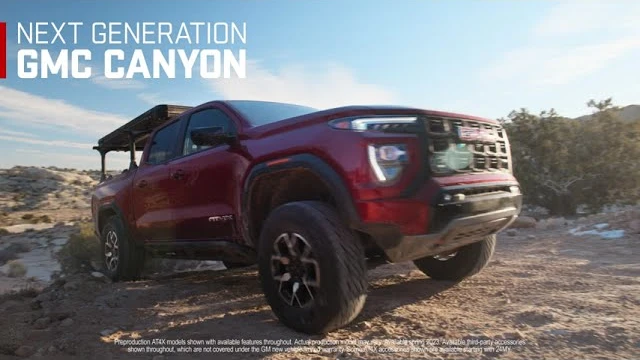
- 2027 GMC Canyon 4 wheel drive models are best evaluated by drivetrain, lockers, tires, and trail equipment.
- AT4X capability centers on front and rear lockers, 33-inch tires, 17-inch wheels, and standard rock rails.
- Engine update raises output to 350 horsepower and 455 lb-ft of torque for the 2027 model.
- Towing expectations vary by configuration, with 7,700 pounds cited for the base truck and 6,000 for ZR2.
- Best setup depends on whether your priority is daily comfort, trail clearance, towing, or maximum protection.
2027 GMC Canyon 4 wheel drive Overview
The 2027 GMC Canyon 4 wheel drive conversation is primarily about how the truck combines midsize dimensions with trail-focused hardware. The 2027 Canyon retains the familiar exterior design while receiving important powertrain and refinement updates. The available off-road equipment makes it suitable for drivers who want to reach difficult terrain without giving up comfortable road manners on the trip home.
The most significant reported change is under the hood. Output increases to 350 horsepower and 455 lb-ft of torque, supported by a different turbocharger, a higher-pressure fuel-injection system, and piston changes. Performance-shift programming is also designed to keep the engine in a useful power band between approximately 2,000 and 4,000 rpm.
Video Highlights:
- The 2027 Canyon receives a reported power increase from 310 to 350 horsepower.
- The AT4X is discussed with front and rear lockers for challenging terrain.
- The truck uses 33-inch tires with 17-inch wheels in the featured off-road configuration.
- Rock rails are standard on the AT4X and are designed for frame-mounted protection.
- The truck remains oriented toward both trail driving and comfortable road use.
The Canyon’s midsize footprint is one of its practical advantages. A narrower body and shorter overall profile can make it easier to position between trees, rocks, and tight trail obstacles than a full-size truck. That size also helps the truck remain manageable during everyday driving.
| Feature | 2027 Canyon reference | Why it matters |
|---|---|---|
| Engine output | 350 horsepower | More reserve for acceleration and trail climbs |
| Torque | 455 lb-ft | Supports low-speed control and towing response |
| Turbocharger | Updated design | Contributes to the revised powertrain |
| Fuel system | Higher-pressure injection | Part of the engine update |
| Engine programming | Keeps performance shifts near 2,000–4,000 rpm | Helps maintain usable response |
| Exterior design | Largely carried over | Buyers should focus on equipment differences |
Treat “4 wheel drive” as the starting point, not the entire specification. Lockers, tire size, underbody protection, suspension equipment, and available clearance determine how confidently the truck handles a trail.
Off-Road Equipment and Trim Priorities
A four-wheel-drive Canyon can serve several different roles, so the right configuration depends on how often you leave the pavement. A daily driver may benefit more from quiet operation and manageable dimensions, while a serious trail user may prioritize lockers, rock rails, specialized tires, and additional protection.
The AT4X is the clearest reference point for the most trail-focused standard equipment discussed in the available material. It includes front and rear lockers, 33-inch tires, 17-inch wheels, and standard rock rails. Those features help improve traction and protect the lower sides of the truck when obstacles become uneven or narrow.
The AEV Edition sits above the AT4X in the off-road hierarchy described in the reference material. It adds 35-inch tires, additional protection, and AEV skid plates. However, a taller and more heavily equipped truck may not be the most convenient choice for every driver, especially when daily access, garage height, and on-road comfort matter.
Everyday 4WD Focus
- Balanced road manners
- Midsize footprint
- Suitable for commuting and weekend trails
- Prioritize comfort and visibility
AT4X Focus
- Front and rear lockers
- 33-inch tires
- 17-inch wheels
- Standard frame-mounted rock rails
AEV Focus
- 35-inch tires
- Additional underbody protection
- AEV skid plates
- Built for more demanding trail conditions
| Equipment | Base-oriented use | AT4X reference | AEV reference |
|---|---|---|---|
| Front locker | Not established in supplied material | Included | Additional off-road focus |
| Rear locker | Not established in supplied material | Included | Additional off-road focus |
| Tire size | Not specified | 33 inches | 35 inches |
| Wheel size | Not specified | 17 inches | Not specified |
| Rock rails | Not specified | Standard | Additional protection focus |
| Skid plates | Not specified | Off-road protection | AEV skid plates |
| Trail character | General utility | Serious trail capability | Maximum equipment emphasis |
Lockers should be used deliberately. A locked axle can help maintain forward movement when a wheel loses traction, but it can also increase tire scrub and reduce the need for careful line selection. Engage the appropriate system according to the trail surface, obstacle, and manufacturer instructions.
Larger tires and additional protection can improve trail performance while also changing approach height, entry access, ride feel, and operating costs. Confirm the truck’s dimensions and equipment before committing to an AEV-style setup.
Step-by-Step 4WD Setup Guide
Use this process to evaluate a 2027 Canyon before a trail trip. The goal is not to activate every feature immediately, but to match the truck’s equipment to the terrain and maintain a controlled pace.
Confirm the Drivetrain and Equipment
Verify that the specific Canyon has the four-wheel-drive hardware and off-road equipment you expect. Check the window sticker, owner materials, and dealer documentation rather than assuming that every Canyon trim uses the same configuration.
Inspect Tires and Protection
Check tire condition, tread depth, wheel damage, rock rails, and visible underbody protection. The featured AT4X reference uses 33-inch tires and 17-inch wheels, while the AEV reference uses 35-inch tires.
Select a Conservative Drive Mode
Begin with the manufacturer-recommended setting for the surface. Keep your speed controlled and allow the truck’s torque to work instead of relying on momentum. Smooth throttle inputs are especially useful on loose climbs.
Use Lockers Only When Needed
Engage front or rear locking hardware according to the owner’s instructions and trail conditions. Use a straight, low-speed line where possible, and disengage the system when it is no longer appropriate.
Recheck the Truck After the Trail
Inspect the tires, wheels, rock rails, recovery points, and lower body after driving over rocks or deep ruts. Remove debris and note any damage before returning to normal road travel.
| Trail condition | Recommended approach | Main concern |
|---|---|---|
| Gravel road | Moderate speed, smooth inputs | Loose surface and reduced braking grip |
| Mud | Maintain steady momentum | Wheel spin and packed tread |
| Rocky climb | Slow line selection, lockers when appropriate | Underbody contact |
| Deep ruts | Cross carefully and protect sidewalls | Suspension and tire damage |
| Steep descent | Controlled speed and consistent braking | Heat and loss of traction |
The Canyon’s size is useful in tight terrain, but size alone does not remove risk. Walk difficult sections when visibility is limited, identify the safest tire path, and avoid entering an obstacle that cannot be exited with the available traction and clearance.
The most repeatable trail technique is controlled progress: choose the line first, use steady throttle, avoid unnecessary wheel spin, and inspect the truck after difficult sections.
Towing, Road Comfort, and Daily Use
The 2027 Canyon is not only an off-road truck. Its appeal comes from combining trail capability with a comfortable return trip, which makes the platform more versatile than a vehicle designed solely for low-speed obstacles.
The supplied reference cites different towing capacities by configuration: 7,700 pounds for the base truck and 6,000 pounds for the ZR2. These figures should not be treated as interchangeable. Payload, hitch equipment, trailer design, passengers, cargo, road conditions, and the truck’s exact certification can all affect a safe towing plan.
| Configuration reference | Cited towing capacity | Practical interpretation |
|---|---|---|
| Base truck | 7,700 pounds | Highest cited towing figure in the supplied material |
| ZR2 | 6,000 pounds | Lower cited figure despite its off-road focus |
| AT4X | Not specified | Confirm the exact rating for the selected vehicle |
| AEV Edition | Not specified | Confirm equipment and certification before towing |
For daily driving, the 2027 model adds refinement rather than a radical visual redesign. Higher trims are described with acoustic side glass, which can reduce outside noise. A universal garage-door opener is also reported as a new convenience feature, with capacity for up to eight location-based settings according to the supplied reference.
The heads-up display is another distinction discussed between the Canyon and its Colorado counterpart. It can keep key information in the driver’s line of sight, which may be useful on trails where repeatedly looking down at the instrument cluster is inconvenient. Polarized sunglasses can affect heads-up display visibility, so test the system with the eyewear you normally use.
Always verify the exact towing and payload ratings for the individual truck. The 7,700-pound and 6,000-pound figures apply to different configuration references and should not be used as a universal 2027 Canyon rating.
For current ordering information and final equipment details, review the official GMC Canyon page before purchasing. Check the final window sticker and owner documentation because availability can vary by configuration and market.
Ownership Checklist and Buying Priorities
A thoughtful inspection can prevent a mismatch between the truck you want and the truck you actually need. Start with the type of terrain you drive most often, then evaluate equipment in order of importance.
Traction
- Front and rear lockers
- Appropriate four-wheel-drive system
- Correct tire tread
Protection
- Rock rails
- Skid plates
- Recovery equipment
Utility
- Towing requirement
- Bed accessories
- Trailer equipment
Comfort
- Acoustic side glass
- Heads-up display
- Daily driving position
2027 Canyon Evaluation Checklist:
- Confirm the exact four-wheel-drive and locker configuration
- Match tire size and protection equipment to your regular trails
- Verify the truck’s certified towing and payload ratings
- Inspect visibility, ride comfort, and available convenience features
- Review final equipment and pricing with an official GMC source
The best choice is not automatically the tallest or most heavily equipped version. A driver who spends most of the year on pavement may prefer the balanced behavior of a less specialized configuration. Someone who regularly tackles rocks, ledges, or deep ruts may place greater value on lockers, rock rails, larger tires, and added protection.
Before finalizing a purchase, compare the truck’s equipment against your actual use:
| Priority | Feature to verify | Why it matters |
|---|---|---|
| Trail traction | Lockers and four-wheel-drive hardware | Helps manage uneven grip |
| Trail protection | Rock rails and skid plates | Reduces exposure to obstacle damage |
| Towing | Configuration-specific rating | Prevents overestimating capacity |
| Comfort | Acoustic glass and display features | Improves long road trips |
| Fit | Tire size and overall height | Affects access, storage, and maneuverability |
Choose the equipment you will use regularly. A balanced Canyon with the right traction and protection can be more useful than an oversized setup that creates unnecessary daily compromises.
2027 GMC Canyon 4 wheel drive FAQ
Q: What makes the 2027 GMC Canyon 4 wheel drive setup useful off-road?
Its value comes from the combination of a midsize footprint, available off-road hardware, strong turbocharged output, and equipment such as front and rear lockers on the AT4X reference. The right configuration depends on the terrain and the driver’s experience.
Q: How much horsepower does the 2027 GMC Canyon have?
The supplied 2027 reference reports 350 horsepower and 455 lb-ft of torque, up from the previously cited 310 horsepower. The update includes a different turbocharger, higher-pressure fuel injection, piston changes, and revised performance-shift programming.
Q: Which Canyon is better for serious trails, AT4X or AEV Edition?
The AEV Edition is positioned as the more heavily equipped option, with 35-inch tires and additional protection including AEV skid plates. The AT4X remains a strong trail-oriented choice with 33-inch tires, front and rear lockers, 17-inch wheels, and standard rock rails.
Q: Can every 2027 Canyon tow 7,700 pounds?
No. The supplied material cites 7,700 pounds for the base truck and 6,000 pounds for the ZR2. Always confirm the exact rating for the specific vehicle, including its equipment, payload, hitch setup, and certification.
Use the 2027 Canyon’s configuration details as a checklist, then confirm final specifications through official GMC documentation before ordering or towing.