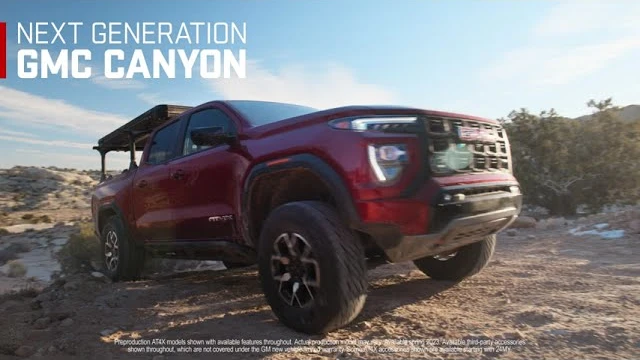
- 2027 GMC Canyon updates include a reported increase to 350 horsepower and 455 lb-ft of torque.
- New engine hardware includes a different turbocharger, higher-pressure fuel injection, and piston changes.
- AT4X capability remains centered on front and rear lockers, 33-inch tires, rock rails, and 17-inch wheels.
- Towing figures are listed at 6,000 pounds for the ZR2 and 7,700 pounds for the base truck.
- Cabin refinements include available acoustic side glass and a programmable universal garage door opener.
2027 GMC Canyon Updates: What Changed
The 2027 GMC Canyon updates point to a targeted refinement rather than a major visual redesign. The exterior is described as largely carried over, while the most important changes focus on the turbocharged engine, shift behavior, cabin quietness, wheel styling, and convenience equipment. That approach keeps the Canyon’s established midsize-truck formula intact while addressing performance and daily usability.
The reported power upgrade is the headline change. Output rises from 310 horsepower to 350 horsepower, while torque reaches 455 lb-ft. The increase is supported by revised engine hardware rather than a simple software adjustment. The changes discussed include a different turbocharger, a higher-pressure fuel-injection system, and piston revisions.
Video Highlights:
- The reported engine output rises to 350 horsepower and 455 lb-ft of torque.
- Performance shifting is tuned to keep the engine in a stronger portion of its power band.
- AT4X equipment includes front and rear lockers, 33-inch tires, and standard rock rails.
- The truck retains a familiar exterior while adding selected convenience and refinement features.
| Update area | Reported 2027 detail | Practical effect |
|---|---|---|
| Horsepower | 350 hp, up from 310 hp | Stronger acceleration potential |
| Torque | 455 lb-ft | More useful low- and mid-range pull |
| Turbocharger | Different turbo hardware | Supports the revised power output |
| Fuel system | Higher-pressure fuel injection | Part of the engine update |
| Pistons | Revised piston changes | Supports the updated powertrain |
| Exterior | Largely carried over | Familiar Canyon appearance |
| Wheel finish | Straight black on the featured truck | New visual detail for 2027 |
The 2027 refresh is most meaningful for drivers who value stronger acceleration and trailer confidence but still want the Canyon’s existing size and trail-focused layout.
Performance Focus
- 350 horsepower
- 455 lb-ft of torque
- Revised turbo and fuel system
Trail Focus
- Front and rear lockers on AT4X
- 33-inch tires
- Frame-mounted rock rails
Daily-Use Focus
- Available acoustic side glass
- Universal garage door opener
- Heads-up display availability
Powertrain and On-Road Behavior
The updated four-cylinder turbo engine is designed to deliver more performance without changing the Canyon’s basic character. The engineering changes are significant on paper, but the goal is not simply maximum output. The revised calibration also emphasizes keeping the engine in a more useful operating range during performance shifts.
The reported shift strategy works to hold the engine between approximately 2,000 and 4,000 rpm during performance-oriented driving. That range is intended to keep the truck closer to its stronger power band instead of allowing unnecessary drops in engine speed.
Engine sound has also been refined. The updated engine is described as having less combustion noise and a deeper tone than the previous version. Sound enhancement remains part of the cabin experience, but the calibration is intended to create a fuller sound without overwhelming occupants.
| Powertrain consideration | 2027 direction | What to watch |
|---|---|---|
| Acceleration | Higher output than the previous 310-hp setup | Noticeability may vary by load and driving style |
| Turbo response | New turbocharger | Evaluate response during passing and hill climbs |
| Shift behavior | Keeps the engine near 2,000–4,000 rpm in performance shifting | Useful for responsive driving |
| Engine sound | Less combustion noise with a deeper tone | Cabin sound remains intentionally controlled |
| Trailer performance | Extra horsepower is not identified as the towing limit | Cooling and chassis limits remain important |
Establish Your Baseline
Drive the truck in normal mode before using performance-oriented shifting. Note throttle response, engine noise, and how quickly the transmission selects a lower gear.
Test the Power Band
Use moderate acceleration on a safe road and observe whether the engine stays within the reported 2,000–4,000 rpm range during stronger shifts.
Add Load Carefully
If you tow, evaluate acceleration, braking feel, and transmission behavior with a properly matched trailer. Do not treat the horsepower increase as an automatic increase in tow rating.
Compare Daily Refinement
Listen for engine and road noise at steady speed, then check whether the cabin feels quieter on higher trims equipped with acoustic side glass.
The reported power increase does not automatically change the truck’s tow rating. Use the rating assigned to the specific configuration and confirm equipment requirements before hauling.
AT4X and Off-Road Equipment
The Canyon’s off-road identity remains one of its clearest advantages. The AT4X is described with both front and rear locking differentials, a combination that gives the truck added control when traction becomes uneven. The featured configuration also uses 33-inch tires on 17-inch wheels and includes standard rock rails.
The rock rails are frame-mounted rather than body-mounted. That distinction matters on rocky trails because frame mounting provides a sturdier attachment point for contact protection. They are also removable, and an accessory step can be installed onto the rail mounting points for easier entry.
The larger AEV Edition sits above the AT4X in the off-road hierarchy. Its highlighted equipment includes 35-inch tires, additional protection, and boron-steel skid plates. Those upgrades make it more specialized for demanding terrain, while the standard AT4X appears better balanced for drivers who split time between trails and paved roads.
| Configuration or feature | Equipment described | Best use |
|---|---|---|
| AT4X | Front and rear lockers, 33-inch tires, 17-inch wheels | Balanced trail and road use |
| Rock rails | Standard on AT4X, frame-mounted | Side protection on rocky terrain |
| AEV Edition | 35-inch tires, added protection, boron-steel skid plates | More specialized off-road driving |
| Accessory step | Bolts onto the rock-rail mounting area | Easier cab access |
| Drivetrain accessory provision | Frames are equipped for dealer-installed additional shocks | Owner-directed trail customization |
The strongest AT4X argument is versatility: it combines serious traction equipment with a size that remains manageable on narrow trails and comfortable on the drive home.
For trail preparation, focus on the equipment that affects control and protection first:
- Confirm the truck has the intended locker configuration.
- Inspect tire condition and sidewall protection before a difficult route.
- Check that rock rails and skid protection are securely fitted.
- Use the available heads-up display to reduce unnecessary glances away from the trail.
- Remember that added height and larger tires can affect entry, visibility, and daily garage clearance.
Towing, Cabin Comfort, and Convenience
The reported towing figures vary by configuration. The ZR2 is listed at 6,000 pounds, while the base truck is listed at 7,700 pounds. These figures should be treated as configuration-specific reference points, not as a universal rating for every Canyon.
The additional horsepower is not described as the limiting factor for trailer capacity. Instead, towing capability depends on the truck’s overall engineering, including cooling, chassis design, braking, hitch equipment, and weight distribution. Buyers should therefore match the trailer to the exact vehicle specification.
Inside, the 2027 truck keeps a familiar layout while adding selected refinement. Higher-trim GMC models are described as offering acoustic side glass, which can reduce outside noise. A heads-up display is also available on the Canyon and can be useful when driving off-road because key information remains in the driver’s forward view.
| Use case | Reported reference | Buying implication |
|---|---|---|
| Base truck towing | 7,700 pounds | Highest listed towing figure in the supplied material |
| ZR2 towing | 6,000 pounds | More trail-focused equipment with a lower listed rating |
| Family use | Suitable for a family of four in the discussed experience | Rear-seat space remains a midsize-truck compromise |
| Cabin quietness | Acoustic side glass on higher trims | Consider for frequent highway driving |
| Driver information | Available heads-up display | Helpful for road and trail visibility |
| Garage convenience | Universal opener with up to eight programmable locations | Useful for multiple homes or properties |
A midsize truck still involves compromises in rear-seat and bed space. The Canyon’s appeal comes from combining usable family transportation, trail ability, and manageable exterior dimensions.
The universal garage door opener is another small but practical improvement. The system is described as supporting up to eight programmed locations and using location-based prompts. That makes it more useful for drivers who regularly move between a home, cabin, or other destinations.
2026 Buyer Checklist for the 2027 Model
Use this checklist to separate the updates that matter most for your driving pattern. A buyer who spends most of the time commuting may prioritize cabin quietness, the heads-up display, and garage-door convenience. A trail-focused owner may place front and rear lockers, tires, rock rails, and underbody protection higher on the list.
The most important comparison is not simply the horsepower number. Consider how the truck will be used, whether towing is frequent, and whether the chosen trim includes the equipment that would otherwise require accessories.
Before You Choose:
- Confirm the exact trim’s horsepower, torque, towing rating, and included equipment
- Check whether acoustic side glass and the heads-up display are included
- Verify that the truck has the desired locker, tire, wheel, and rock-rail setup
- Match trailer weight to the configuration-specific rating and required hitch equipment
- Inspect accessory compatibility before adding steps, shocks, snorkel equipment, or bed protection
| Priority | Recommended check | Why it matters |
|---|---|---|
| 1 | Verify trim and drivetrain | Equipment and towing figures vary |
| 2 | Confirm tire and protection package | Trail hardware affects capability and clearance |
| 3 | Review towing requirements | The rating is configuration-specific |
| 4 | Test cabin features | Noise and visibility improvements are personal preferences |
| 5 | Plan accessories | Dealer-installed and bolt-on equipment may differ |
Choose the AT4X when trail capability and road comfort must coexist. Consider the more specialized AEV Edition only when its larger tires and added protection fit your regular terrain.
2027 GMC Canyon Updates FAQ
Q: What are the main 2027 GMC Canyon updates?
The key reported changes are 350 horsepower, 455 lb-ft of torque, a different turbocharger, higher-pressure fuel injection, piston revisions, updated performance shifting, available acoustic side glass, a new wheel finish on the featured truck, and a universal garage door opener.
Q: Does the 2027 Canyon have more towing capacity because of the power increase?
Not according to the supplied information. The power increase is not identified as the towing limitation. The listed references are 6,000 pounds for the ZR2 and 7,700 pounds for the base truck, so buyers should confirm the rating for the exact configuration.
Q: What makes the AT4X suitable for off-road driving?
The AT4X is described with front and rear lockers, 33-inch tires on 17-inch wheels, and standard frame-mounted rock rails. These features support traction, side protection, and control on uneven trails.
Q: How is the AEV Edition different from the AT4X?
The AEV Edition is positioned as the more specialized off-road choice. Its highlighted equipment includes 35-inch tires, additional protection, and boron-steel skid plates, while the AT4X emphasizes a broader road-and-trail balance.
The 2027 Canyon update is centered on useful engineering changes rather than a dramatic redesign. More power, improved shift behavior, familiar AT4X hardware, and added cabin convenience make it a stronger all-purpose midsize truck candidate.